The first time I decided to participate in a solid month of posting, I did it. This time, on day two, I'm off the wagon. By 20 freakin' minutes (give or take).
So, to give up the ghost and just post when my fickle muse speaks, or continue in the spirit of [Really Awkward Abbreviation Month]? For now, I think I'll continue in its spirit. My muse needed a kick in the ass anyway. (In all fairness, we're on speaking terms again, she and I.)
More tomorr--er, later today.
Showing posts with label nablopomo. Show all posts
Showing posts with label nablopomo. Show all posts
Monday, March 3, 2008


Saturday, March 1, 2008
The usefulness of a liberal arts degree
I've always been a reader. Whatever I could get my hands on, I read. I had little supervision, so some of what I read was probably beyond my grasp at the time. But I self-censored, delicately avoiding anything too "edgy."
And then I went to college, got one of them fancy-pants liberal arts educations, specifically, an English degree (and a second one!). I read all sorts of stuff, things about death and ghosts and incest and many a piece of literature with all sorts of bawdy plots (what education wouldn't be complete without Shakespeare?).
In that time, my "weirdness threshold" went up significantly. I have yet to read something so utterly offensive as to make me put it aside in horror. Incest? So Greek tragedy-esque. Romantic-era gothic fiction containing a date-rape scenario? Mildly disturbing, but kinda quaint. Stories with homoerotic undertones? Yawn.
I was discussing this with a couple people recently.
"Yeah, I mean, I was reading this book once where necrophilia was a factor, and this little part of me went, 'well, that's disturbing,' and I read on."
"What's necrophilia?" one person asked.
"It's when people like screwing corpses," my dear, sweet grandmother, whose attitudes about sex I could swear are Victorian, explained in a stage whisper so the other people in the coffee shop couldn't hear.
"Oh."
Which made me think, where did I originally learn what necrophilia was?
Probably from a book.
And then I went to college, got one of them fancy-pants liberal arts educations, specifically, an English degree (and a second one!). I read all sorts of stuff, things about death and ghosts and incest and many a piece of literature with all sorts of bawdy plots (what education wouldn't be complete without Shakespeare?).
In that time, my "weirdness threshold" went up significantly. I have yet to read something so utterly offensive as to make me put it aside in horror. Incest? So Greek tragedy-esque. Romantic-era gothic fiction containing a date-rape scenario? Mildly disturbing, but kinda quaint. Stories with homoerotic undertones? Yawn.
I was discussing this with a couple people recently.
"Yeah, I mean, I was reading this book once where necrophilia was a factor, and this little part of me went, 'well, that's disturbing,' and I read on."
"What's necrophilia?" one person asked.
"It's when people like screwing corpses," my dear, sweet grandmother, whose attitudes about sex I could swear are Victorian, explained in a stage whisper so the other people in the coffee shop couldn't hear.
"Oh."
Which made me think, where did I originally learn what necrophilia was?
Probably from a book.
Friday, November 30, 2007
With apologies to T.S. Eliot
This is the way Nablopomo ends
This is the way Nablopomo ends
This is the way Nablopomo ends
Not with a bang but a whimper.
Heh. I had to do that, just had to. T.S. Eliot is probably rolling in his grave right now (original source here). And for the record, I have been measuring my life out not in coffee spoons, but in coffee cups. OK, I'll leave Eliot alone now. I was just having a bit of fun with him, no malicious intent. I really can't criticize too severely the man who wrote the basis for one of my favorite musicals, Cats.
So. This is the end of an intense month. I went back through my old blogs to see what I'd written on Nov. 30 for the past 6 years, but there are generally fewer than a handful of posts each November (peak posting months, not surprisingly, are June, July, and August). It stretched me, mentally, this posting every day deal, but I stubbornly vowed I'd do it and I did. Quality, what I did have, at any rate, took a bit of a hit, but it also pushed me to hit publish on a few things I might've otherwise talked myself out of. I didn't post every idea that came to mind, either. I spared my readers a rant on the other day's outrages in the Wal-Mart parking lot (venting about the big box chain is like shooting fish in a barrel--far too easy and makes the shooter appear unambitious and a little hackneyed). I didn't post about the random conversations I've had with students (for one thing, about my tendency to wear my winter coat, wrist warmers, and flip-flops). I didn't post about my response to my peers' tendency to be marrying and engaging at an alarming rate recently (for one thing, my views on marriage are... uh... cynical and could appear bitter). I didn't post much about my job dissatisfactions. I kept the nagging metaphysical stuff to a minimum, even though those questions have flared back up again. For the most part, I think I kept from making an ass of myself.
I did intend to post about the albums that rock my world, which I plan to do when I have more time, as I want to give them the proper homage. I also have some interesting news articles bookmarked to write about, again, when I've the time to give them thoughtful treatment.
A student once told me, in defense of procrastination, pressure makes diamonds. Maybe, I replied, but it doesn't polish them. I don't know if National Blog Posting Month created any diamonds, but it at least created small nuggets of thoughts, some of which I like. And that's worth something.
This is the way Nablopomo ends
This is the way Nablopomo ends
Not with a bang but a whimper.
Heh. I had to do that, just had to. T.S. Eliot is probably rolling in his grave right now (original source here). And for the record, I have been measuring my life out not in coffee spoons, but in coffee cups. OK, I'll leave Eliot alone now. I was just having a bit of fun with him, no malicious intent. I really can't criticize too severely the man who wrote the basis for one of my favorite musicals, Cats.
So. This is the end of an intense month. I went back through my old blogs to see what I'd written on Nov. 30 for the past 6 years, but there are generally fewer than a handful of posts each November (peak posting months, not surprisingly, are June, July, and August). It stretched me, mentally, this posting every day deal, but I stubbornly vowed I'd do it and I did. Quality, what I did have, at any rate, took a bit of a hit, but it also pushed me to hit publish on a few things I might've otherwise talked myself out of. I didn't post every idea that came to mind, either. I spared my readers a rant on the other day's outrages in the Wal-Mart parking lot (venting about the big box chain is like shooting fish in a barrel--far too easy and makes the shooter appear unambitious and a little hackneyed). I didn't post about the random conversations I've had with students (for one thing, about my tendency to wear my winter coat, wrist warmers, and flip-flops). I didn't post about my response to my peers' tendency to be marrying and engaging at an alarming rate recently (for one thing, my views on marriage are... uh... cynical and could appear bitter). I didn't post much about my job dissatisfactions. I kept the nagging metaphysical stuff to a minimum, even though those questions have flared back up again. For the most part, I think I kept from making an ass of myself.
I did intend to post about the albums that rock my world, which I plan to do when I have more time, as I want to give them the proper homage. I also have some interesting news articles bookmarked to write about, again, when I've the time to give them thoughtful treatment.
A student once told me, in defense of procrastination, pressure makes diamonds. Maybe, I replied, but it doesn't polish them. I don't know if National Blog Posting Month created any diamonds, but it at least created small nuggets of thoughts, some of which I like. And that's worth something.
Thursday, November 29, 2007
Words, words, words--and naught but questions to show for them
My formatting's wonky. Thanks for the hint, Blogspot. Geez.
Wednesday, November 28, 2007
"And Yet the Books"
A poem from Scanning the Century: The Penguin Book of the Twentieth Century in Poetry, edited by Peter Forbes.
"And Yet the Books" by Czeslaw Milosz, translated by Robert Hass
More of his poems are available here.
"And Yet the Books" by Czeslaw Milosz, translated by Robert Hass
And yet the books will be there on the shelves, separate beings,
That appeared once, still wet
As shining chestnuts under a tree in autumn,
And, touched, coddled, began to live
In spite of fires on the horizon, castles blown up,
Tribes on the march, planets in motion.
'We are,' they said, even as their pages
Were being torn out, or a buzzing flame
Licked away their letters. So much more durable
Than we are, whose frail warmth
Cools down with memory, disperses, perishes.
I imagine the earth when I am no more:
Nothing happens, no loss, it's still a strange pageant,
Women's dresses, dewy lilacs, a song in the valley.
Yet the books will still be there on the shelves, well born,
Derived from people, but also from radiance, heights.
More of his poems are available here.
Tuesday, November 27, 2007
"Three cheers for tyranny, unapologetic apathy..."
Grading beckons. I am tired. I'm taking a lifeline, here: the rest of this post is something I wrote a year ago to the day, a post from my first semester of teaching. It was written at a moment where my idealism and my pragmatism had a head-on collision. The idealism's been a bit worse for the wear, methinks.
A year later, I think I've finally started to convince myself.
I've made up my mind: I am going to stop caring.
I only get paid to teach, not to care. I don't have the time or energy to do so; I'm not getting paid for it. I just have to make sure my students can write at the college level. Well, most of them are there. My job's done.
For the rest of the semester, I will just be a grading machine. Comma splice here, run-on there. Good development of ideas. Relevance of info? Transition needed here. Cut the wordiness there.
I will stop taking a personal interest in the writing itself and in the development of the writer. While this means I no longer will receive the thrill of seeing a struggling student finally "get it," it also spares me the frustration when students don't or when they sabotage themselves needlessly. It also uses less ink, so I won't go through as many pens--quite economic, really.
I will no longer care when they blow off their work. Hey, it's less grading, right? A zero is much more cut and dry than agonizing over the rubric to determine whether a paper is a B or C. It's college, and they're responsible for their own work. Again, by not caring, I'll be spared the twinge of disappointment when they don't come through. Once again, I'll miss out on the joy of seeing a previously slacking student finally start taking things seriously and pull up his or her grade, but the trade-off is worth it in easier sleeping.
By eliminating the emotional investment in my job, I will become that much more effective. Classes will be well-regulated sessions with very strict lesson goals and a complete lack of flexibility. No getting off topic, no negotiation, no room for opinions or options. It'll be like an assembly line of information, a one-way communication channel from teacher to students. Hey, it worked for centuries, right? Maybe those dead white guys really were on to something.
I don't know why it's taken so long for me to realize this; I think my emotional investment in teaching had clouded my vision. Whatever the reason, I've straightened my thinking up. Apathy is the way to go.
... Riiiiiiight... now if I could just convince myself...
Monday, November 26, 2007
This is ridiculous
Day 26 of National Blog Posting Month... The end is in sight. I'm tenacious. If I commit to something, whether it's a committee, an event, or even a mindset, I follow through pretty well. Sometimes this works in my favor; other times, it makes me my own worst enemy.
In this case, it's just a month of posting stuff once per day. The quality may vary radically, and the frequency of posting has led me to post more pictures, but dagnabit, I'm completing what I set out to do. And when it's over? I'll probably go back to posting about 3 times per week. As far as bloggers go, I think that makes me pretty consistent.
There is, however, one thing I want to try. This idea is triggered in part by a couple posts at The Skewed View about wasting time away. I haven't his fortitude to pull the plug on my Facebook as I did with Myspace, but I do acknowledge that too much of my time gets frittered away on the Internet. Facebook is but one culprit; it shares the time suckage with checking multiple e-mail addresses, checking site stats and Google Reader, popping in at my old journal to see what the friends I made there are up to, goofing around on Youtube, spending time on Last.fm. Oh, there could be legitimate reasons for those things: perhaps there are e-mails from friends (most likely e-mails are specials from Borders, mailings from the coffee shop, catalog specials, and the like), no legit excuse on the site stats thing but egotism (an average 10 hits per day!), I rarely comment on people's journals anymore even if I skim them, no excuse for Youtube since it's usually just for music and typically ends up somehow on inane videos like talking cats, and in my defense I typically have Last.fm going in the background to grading or some such thing.
It all adds up to more time than I'd care to calculate. I wondered to myself if I could go a week without the computer (which, to be honest, is synonymous with "Internet," the real culprit), triggering a painful knee-jerk response. No can do, and what about my employee e-mail? I should keep up with that, at least.
How about two days, then, as a test of will? Two days of only using the computer for necessities. It seems so simple, and it is... in theory. Communism seems simple in theory, too, and look how well that's worked out. No, entire economies won't go to pot with my little experiment, but I anticipate the prospect with about as much glee as a peasant girding up to go stand for hours in the bread line. (Note to self: bad simile. Quit it with the melodrama, you spoiled bourgeois baby.)
This will be after November, though--wouldn't want to drop the ball on NaBloPoMo with the end so close in sight. That would mean the first of December to start my experiment, a Saturday, running through Sunday. Would that mean actually going out and doing something that involves interacting with human beings? Doing my grading in a more efficient manner? Not being online at 2 and 3 a.m.? Taking that time to read or do something productive? Radical concepts.
I'd need to establish rules ahead of time: only work e-mail, no exceptions. No Internet otherwise. Shoot, no computer, period. I'll shut it down. Music? Charge the iPod in advance. Yeesh... I haven't synced any new music onto it since Spring semester... it's an odd mixture of Bayside, Muse, 30 Seconds to Mars, Bullet For My Valentine, Rise Against, Emery, and Within Temptation (I think I'll leave it be for now, as I never installed iTunes on this computer). If I want to play Solitaire, I can pull out a deck of cards. Need to write something? I can use pen and paper.
I can't think of anything else. I think I'm gonna do it even though my hands feel a bit clammy at the prospect. See that? I'm committing to it.
In this case, it's just a month of posting stuff once per day. The quality may vary radically, and the frequency of posting has led me to post more pictures, but dagnabit, I'm completing what I set out to do. And when it's over? I'll probably go back to posting about 3 times per week. As far as bloggers go, I think that makes me pretty consistent.
There is, however, one thing I want to try. This idea is triggered in part by a couple posts at The Skewed View about wasting time away. I haven't his fortitude to pull the plug on my Facebook as I did with Myspace, but I do acknowledge that too much of my time gets frittered away on the Internet. Facebook is but one culprit; it shares the time suckage with checking multiple e-mail addresses, checking site stats and Google Reader, popping in at my old journal to see what the friends I made there are up to, goofing around on Youtube, spending time on Last.fm. Oh, there could be legitimate reasons for those things: perhaps there are e-mails from friends (most likely e-mails are specials from Borders, mailings from the coffee shop, catalog specials, and the like), no legit excuse on the site stats thing but egotism (an average 10 hits per day!), I rarely comment on people's journals anymore even if I skim them, no excuse for Youtube since it's usually just for music and typically ends up somehow on inane videos like talking cats, and in my defense I typically have Last.fm going in the background to grading or some such thing.
It all adds up to more time than I'd care to calculate. I wondered to myself if I could go a week without the computer (which, to be honest, is synonymous with "Internet," the real culprit), triggering a painful knee-jerk response. No can do, and what about my employee e-mail? I should keep up with that, at least.
How about two days, then, as a test of will? Two days of only using the computer for necessities. It seems so simple, and it is... in theory. Communism seems simple in theory, too, and look how well that's worked out. No, entire economies won't go to pot with my little experiment, but I anticipate the prospect with about as much glee as a peasant girding up to go stand for hours in the bread line. (Note to self: bad simile. Quit it with the melodrama, you spoiled bourgeois baby.)
This will be after November, though--wouldn't want to drop the ball on NaBloPoMo with the end so close in sight. That would mean the first of December to start my experiment, a Saturday, running through Sunday. Would that mean actually going out and doing something that involves interacting with human beings? Doing my grading in a more efficient manner? Not being online at 2 and 3 a.m.? Taking that time to read or do something productive? Radical concepts.
I'd need to establish rules ahead of time: only work e-mail, no exceptions. No Internet otherwise. Shoot, no computer, period. I'll shut it down. Music? Charge the iPod in advance. Yeesh... I haven't synced any new music onto it since Spring semester... it's an odd mixture of Bayside, Muse, 30 Seconds to Mars, Bullet For My Valentine, Rise Against, Emery, and Within Temptation (I think I'll leave it be for now, as I never installed iTunes on this computer). If I want to play Solitaire, I can pull out a deck of cards. Need to write something? I can use pen and paper.
I can't think of anything else. I think I'm gonna do it even though my hands feel a bit clammy at the prospect. See that? I'm committing to it.
Sunday, November 25, 2007
Food for thought
Someone recently shared with me one of those stop-and-make-you-think quotes from Ray Bradbury's Fahrenheit 451. I've read it before (am about due for a re-read, actually), but if you haven't yet, it's a great book; most people are probably familiar with its anti-censorship theme, though Bradbury himself recently said it was actually about the dangers posed to reading by too much television watching. Either interpretation yields a rich, relevant message, and I look forward to re-reading the book with a new interpretive lens. Bradbury is a brilliant writer with brilliant ideas, including this one:
What about you? Who or what have you touched? What will you leave behind?
Everyone must leave something behind when he dies, my grandfather said. A child or a book or a painting or a house or a wall built or a pair of shoes made. Or a garden planted. Something your hand touched some way so your soul has somewhere to go when you die, and when people look at that tree or that flower you planted, you're there. It doesn't matter what you do, he said, so long as you change something from the way it was before you touched it into something that's like you after you take your hands away. The difference between the man who just cuts lawns and a real gardener is in the touching, he said. The lawn-cutter might just as well not have been there at all; the gardener will be there a lifetime.I read the quote once, was ready to pass it over, and stopped to process. I wonder, really, what I've touched and left an impression on--it's not the sort of thing we tend to think about in the rush, rush, rush of the daily grind. I teach, true, and I make some hand-crafted things; perhaps it's self-deprecation, but I don't think I've left my mark. Yet. And I wonder what that mark, that touch, will be, and on whom, and when. I like his word choice--touch--to reach out, to connect, to make meaningful contact, physical or otherwise, with another human being. It seems to be increasingly missing in our daily interactions. But I digress...
What about you? Who or what have you touched? What will you leave behind?
Saturday, November 24, 2007
A travelogue of sorts.
Here, as promised, are the pictures from yesterday's adventure. Blast my not having my camera with me. These shady shots will have to suffice; they're the only tangible record I have of the exploration. It just means I'll have to go again to get better pictures. Until then, here's a mini-travelogue.


Let me take you on a journey. Start here. Which way would you choose? Please say right.
 You chose right. Or correctly. Whatever. C'mon, keep moving. There's lots to see.
 See? If you'd stayed on the paved path, you'd have missed this. Cool, huh? The trees were huge.
 And you'd also have missed this. It's the closest thing we saw to a cave. The mud prohibited further investigation.
 Watch your balance. The leaves under the water vaguely resemble rust.
 What's this about being tired? Need a place to rest for a bit?
 Clearly the art students have been here... There may have been a few goths among them.
 Others have left their marks as well. I didn't. I was merely a passer-by.
 And still others have made more permanent marks. Nature accommodates herself; she has to.
 Finally, something gave us a hunch we should leave. So we did.
 You chose right. Or correctly. Whatever. C'mon, keep moving. There's lots to see.
 See? If you'd stayed on the paved path, you'd have missed this. Cool, huh? The trees were huge.
 And you'd also have missed this. It's the closest thing we saw to a cave. The mud prohibited further investigation.
 Watch your balance. The leaves under the water vaguely resemble rust.
 What's this about being tired? Need a place to rest for a bit?
 Clearly the art students have been here... There may have been a few goths among them.
 Others have left their marks as well. I didn't. I was merely a passer-by.
 And still others have made more permanent marks. Nature accommodates herself; she has to.
 Finally, something gave us a hunch we should leave. So we did.
And thus ends an afternoon's excursion. I encourage you to find your own parks to explore. And for goodness' sake, get off the beaten path. It's OK to walk in the grass. Who knows what you may find.
Friday, November 23, 2007
A better alternative to Black Friday
I had a wonderful time today. It is, in case you were living under a rock, Black Friday, the day to kick off the consumerism that masquerades as Christmas spirit. But my good time had nothing to do with that.
Every year, I ignore the ads, ignore the commercials, ignore the radio--in fact, I avoid unnecessary shopping between Black Friday and about early January. No mass-produced gift basket or unnecessary and overpriced gadget can induce me to voluntarily take on massive crowds, unnavigable aisles, and overworked staff. The touch of claustrophobia and mild tension headache that result from such an excursion are compelling enough reasons not to.
The madness started early this year; some stores, eager to get the jump on the competition, were open Thursday evening. Others decided to open doors at 4 a.m. (sounds more like a bedtime to me than a get-up-and-stand-in-line time) or 5 a.m. "What on earth could be worth getting up that early for?" I pondered aloud the other night as I caught the tail end of a commercial. I was ready to forgo all of that nonsense, that is, until I caught wind of Half Price Books' special for the first 100 customers--a $5 gift card and a tote bag. I even set the alarm to get up; it went off at about 6:30, whereupon I shut it off and said screw that. If I want the five bucks that badly, I'll sell some books back next time I go.
So I went back to sleep, and when I got up, it was to get ready to make the drive out of the city back to the small town where I went to college. Yeah, that drive--the one I realized I kinda liked. The plan: lunch with a good friend at our favorite hole-in-the-wall-homestyle-cooking-and-tea joint. We shared a pot of black currant tea and ordered lunch. I'm proud of myself for trying something new (and liking it, too!), not the same thing I ordered the previous three times we had lunch there. We chatted and caught up, enjoying the atmosphere, the food, and of course, the company. It's hard to stay caught up with friends when they're all working, in grad school, or some combination of the two, and it'd been at least summer since we last got together.
Afterward, we pondered over what to do. There's not too much that doesn't involve shopping, and she, like I, didn't want to mess with that. So we decided to check out a park on the outskirts of town. Best. Decision. Ever. We parked and then set off on the walking trail. Not far in, the path split--one way, straight ahead, the other way, across a bridge. Across the bridge, an unpaved, footworn path through the woods. After a few Robert Frost punchlines, we crossed the bridge. The path forked a few times, and at each junction, we decided which way to take. When we reached the end of one trail, we'd turn back and take the other junction. There were lots of cool things to see--little creeks and rivulets, moss covered rocks and trees, impressive fallen trees, a few impressive rock walls. Eventually, we headed back to the paved trail--only to find another footpaved path to follow. A couple of those turns led us straight into the adjoining grave yard. Others led back to the rock face. Near one rock face (we couldn't decide if it was one of the "caves" that the area was supposed to have), there was a whitish-colored... ball... of something. My friend's first question: "Is that a skull?" Her second question: "Should I kick it?" In the intervening time, of course, we determined it was not a skull, but the incident was good for about 10 minutes or so of chuckling. "I'm blogging this," I said as we made our way back.
One rock wall was quite impressive, but it was a bit eerie--and the mud was a bit thick to slodge through. As I looked at it, a bit of graffiti caught my eye. "Looks like vandals have been here," I remarked. "Or maybe they were Goths," she replied. "Or Visigoths?" I asked.
At the end of the paved trail was a definite indentation in the rock where all manner of graffiti had been sprayed, all sorts of names and initials had been carved, and even some Mayan-looking faces carved into the rock. An occasional beer can or water bottle littered the area. We finally turned back, as it was getting late-ish, but we didn't leave until we'd explored one last footpath.
My hands were getting numb about half an hour in, and I could barely feel them by the time we left. My nose was running about off my face. I was chilled all the way through, but I had a wonderful time. I regretted not bringing my camera, but I snagged a bunch of shots with my cell phone (forthcoming, if I can get the software to work to get them off said phone). But really, there's nothing like tramping through the woods with a good friend, exploring the pathways, cautiously testing your footing on an uneven trail and finding with increasing confidence that you can feel your way through, and, yes, I'm going to sound New Age-y or at least somewhat transcendentalist here, getting out into nature. In places, it was absolutely silent, broken only by a bird twitter or squirrel darting through the leaves. It was perfect, absolutely perfect, and I can't wait to do it again--we only explored part of the park; who knows what the rest will hold.
And that's how I spent most of my Black Friday--with a friend. And that's the best thing to give--or receive--time, attention. Caring. Listening. Laughing. Exploring. The other crap in the stores? Material. Ephemeral.
Don't buy; do. It lasts a hell of a lot longer, costs nothing, and means so much more.
Which leads into one last Thanksgiving nod: I am so thankful for my friends, for their quirks, for their humor, for their intelligence, for their full acceptance of who I am, for the fact that they're there whether I'm looking to have a good time or whether I need someone to listen. I can only hope I've been half as good a friend in return as they have been to me.
Every year, I ignore the ads, ignore the commercials, ignore the radio--in fact, I avoid unnecessary shopping between Black Friday and about early January. No mass-produced gift basket or unnecessary and overpriced gadget can induce me to voluntarily take on massive crowds, unnavigable aisles, and overworked staff. The touch of claustrophobia and mild tension headache that result from such an excursion are compelling enough reasons not to.
The madness started early this year; some stores, eager to get the jump on the competition, were open Thursday evening. Others decided to open doors at 4 a.m. (sounds more like a bedtime to me than a get-up-and-stand-in-line time) or 5 a.m. "What on earth could be worth getting up that early for?" I pondered aloud the other night as I caught the tail end of a commercial. I was ready to forgo all of that nonsense, that is, until I caught wind of Half Price Books' special for the first 100 customers--a $5 gift card and a tote bag. I even set the alarm to get up; it went off at about 6:30, whereupon I shut it off and said screw that. If I want the five bucks that badly, I'll sell some books back next time I go.
So I went back to sleep, and when I got up, it was to get ready to make the drive out of the city back to the small town where I went to college. Yeah, that drive--the one I realized I kinda liked. The plan: lunch with a good friend at our favorite hole-in-the-wall-homestyle-cooking-and-tea joint. We shared a pot of black currant tea and ordered lunch. I'm proud of myself for trying something new (and liking it, too!), not the same thing I ordered the previous three times we had lunch there. We chatted and caught up, enjoying the atmosphere, the food, and of course, the company. It's hard to stay caught up with friends when they're all working, in grad school, or some combination of the two, and it'd been at least summer since we last got together.
Afterward, we pondered over what to do. There's not too much that doesn't involve shopping, and she, like I, didn't want to mess with that. So we decided to check out a park on the outskirts of town. Best. Decision. Ever. We parked and then set off on the walking trail. Not far in, the path split--one way, straight ahead, the other way, across a bridge. Across the bridge, an unpaved, footworn path through the woods. After a few Robert Frost punchlines, we crossed the bridge. The path forked a few times, and at each junction, we decided which way to take. When we reached the end of one trail, we'd turn back and take the other junction. There were lots of cool things to see--little creeks and rivulets, moss covered rocks and trees, impressive fallen trees, a few impressive rock walls. Eventually, we headed back to the paved trail--only to find another footpaved path to follow. A couple of those turns led us straight into the adjoining grave yard. Others led back to the rock face. Near one rock face (we couldn't decide if it was one of the "caves" that the area was supposed to have), there was a whitish-colored... ball... of something. My friend's first question: "Is that a skull?" Her second question: "Should I kick it?" In the intervening time, of course, we determined it was not a skull, but the incident was good for about 10 minutes or so of chuckling. "I'm blogging this," I said as we made our way back.
One rock wall was quite impressive, but it was a bit eerie--and the mud was a bit thick to slodge through. As I looked at it, a bit of graffiti caught my eye. "Looks like vandals have been here," I remarked. "Or maybe they were Goths," she replied. "Or Visigoths?" I asked.
At the end of the paved trail was a definite indentation in the rock where all manner of graffiti had been sprayed, all sorts of names and initials had been carved, and even some Mayan-looking faces carved into the rock. An occasional beer can or water bottle littered the area. We finally turned back, as it was getting late-ish, but we didn't leave until we'd explored one last footpath.
My hands were getting numb about half an hour in, and I could barely feel them by the time we left. My nose was running about off my face. I was chilled all the way through, but I had a wonderful time. I regretted not bringing my camera, but I snagged a bunch of shots with my cell phone (forthcoming, if I can get the software to work to get them off said phone). But really, there's nothing like tramping through the woods with a good friend, exploring the pathways, cautiously testing your footing on an uneven trail and finding with increasing confidence that you can feel your way through, and, yes, I'm going to sound New Age-y or at least somewhat transcendentalist here, getting out into nature. In places, it was absolutely silent, broken only by a bird twitter or squirrel darting through the leaves. It was perfect, absolutely perfect, and I can't wait to do it again--we only explored part of the park; who knows what the rest will hold.
And that's how I spent most of my Black Friday--with a friend. And that's the best thing to give--or receive--time, attention. Caring. Listening. Laughing. Exploring. The other crap in the stores? Material. Ephemeral.
Don't buy; do. It lasts a hell of a lot longer, costs nothing, and means so much more.
Which leads into one last Thanksgiving nod: I am so thankful for my friends, for their quirks, for their humor, for their intelligence, for their full acceptance of who I am, for the fact that they're there whether I'm looking to have a good time or whether I need someone to listen. I can only hope I've been half as good a friend in return as they have been to me.
Tuesday, November 20, 2007
Serendipity
It's a word I'm quite fond of, serendipity. This is my 50th post, but I'm sure I've used the word serendipity a few times. It just trips off the tongue. And it may have something to do with my bookish childhood.
Simply defined, serendipity is making cool discoveries by accident. Observe.
One of my Sitemeter referrals prompted me to follow this search string:
 From there, I stumbled across Redneck Mother's blog. From there, I followed a link she posted to Free Rice. Oh my god, that link is making it to the vices list. It's a vocab quiz of sorts, but with each word you get right, they donate ten grains of rice to the United Nations World Food Program. As you play, it adjusts to your skill level; the top level is 50--I keep stagnating at about 40 (not bad for someone who supposedly writes like a high schooler), but I'm trying to go further. It's nerdy fun, but for a good cause.
And I do feel I should qualify that as nerdy/geeky/whatever. My sister once laughed at me for spending a chunk of a Friday evening playing a game where you place the respective 50 states correctly on a map. Or a simple RPG called Maganic Wars. Hey, I keep myself amused pretty easily.
Simply defined, serendipity is making cool discoveries by accident. Observe.
One of my Sitemeter referrals prompted me to follow this search string:
 From there, I stumbled across Redneck Mother's blog. From there, I followed a link she posted to Free Rice. Oh my god, that link is making it to the vices list. It's a vocab quiz of sorts, but with each word you get right, they donate ten grains of rice to the United Nations World Food Program. As you play, it adjusts to your skill level; the top level is 50--I keep stagnating at about 40 (not bad for someone who supposedly writes like a high schooler), but I'm trying to go further. It's nerdy fun, but for a good cause.
And I do feel I should qualify that as nerdy/geeky/whatever. My sister once laughed at me for spending a chunk of a Friday evening playing a game where you place the respective 50 states correctly on a map. Or a simple RPG called Maganic Wars. Hey, I keep myself amused pretty easily.
Sunday, November 18, 2007
This is... there are no words
From the NY Times Magazine: Sweeping the Clouds Away.
Early episodes of Sesame Street, available on DVD, come with a warning that they may not be suitable for today's preschoolers. Why? Several factors, including Cookie Monster's smoking in the Monsterpiece Theatre pieces, his unhealthy eating habits, Oscar the Grouch's misanthropy...
It's been a few years since I watched the show, but it's a part of my childhood warm-fuzzies. And I turned out... more or less OK. I'm not a smoker, not obese, and only borderline misanthropic. Which leads me to one conclusion:
It must be a strange experience to raise a child in this day and age. On the one hand, kids have cell phones and Internet access from a young age with access to everything the web has to offer, but on the other hand they must be so sheltered. They must be guarded from smoking (a current social bugaboo right now--it makes a convenient scapegoat), they must be shown people indulging only in healthy eating habits (because no doubt mommy or daddy, juggling both parenting and careers, are the very models of healthy eating), and they must be shown a technicolor-bright world where no one is unhappy (because it's that sort of thing that leads these current generations to being the Prozac nation, not increased anxiety from things like pressure to perform on tests and witnessing the violence of our society).
(Gee, but that "wtf" tag has come in more useful than I anticipated.)
Early episodes of Sesame Street, available on DVD, come with a warning that they may not be suitable for today's preschoolers. Why? Several factors, including Cookie Monster's smoking in the Monsterpiece Theatre pieces, his unhealthy eating habits, Oscar the Grouch's misanthropy...
It's been a few years since I watched the show, but it's a part of my childhood warm-fuzzies. And I turned out... more or less OK. I'm not a smoker, not obese, and only borderline misanthropic. Which leads me to one conclusion:
It must be a strange experience to raise a child in this day and age. On the one hand, kids have cell phones and Internet access from a young age with access to everything the web has to offer, but on the other hand they must be so sheltered. They must be guarded from smoking (a current social bugaboo right now--it makes a convenient scapegoat), they must be shown people indulging only in healthy eating habits (because no doubt mommy or daddy, juggling both parenting and careers, are the very models of healthy eating), and they must be shown a technicolor-bright world where no one is unhappy (because it's that sort of thing that leads these current generations to being the Prozac nation, not increased anxiety from things like pressure to perform on tests and witnessing the violence of our society).
(Gee, but that "wtf" tag has come in more useful than I anticipated.)
Saturday, November 17, 2007
Last shots of autumn
I took a 20-minute break from grading earlier this week to go outdoors. After all, autumn won't last forever. Camera in hand, I decided to see what interesting things the yard held in store.
It started at the deck, actually. The leaves are accumulating. If we leave the back door open in the evening, sometimes the wind whips them up against the screen. And sometimes they scratch across the deck, an almost crunching sound, which when combined with the creaks of a settling patio, can be disconcerting. But the leaves looked pretty harmless in the halflight. The great thing about being digital is that I can take pictures just for kicks, just to play with the angles or the content. Those pictures tickle my fancy, but there's nothing spectacular in the composition.
Onward, then. This is what I eventually found:
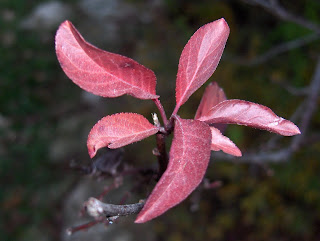 This is a... shrub of sorts. Dunno what it's called, but it's got pretty little pink flowers in the spring.
 Most of the leaves are gone now. I'm a sucker for silhouettes and sunsets, so here ya go.
 OK, so I actually took this one a few weeks ago. It was an accident, actually. The shot I was trying to capture was...

Ah, the benefits of actually using the flash on a grey, gloomy day.
It started at the deck, actually. The leaves are accumulating. If we leave the back door open in the evening, sometimes the wind whips them up against the screen. And sometimes they scratch across the deck, an almost crunching sound, which when combined with the creaks of a settling patio, can be disconcerting. But the leaves looked pretty harmless in the halflight. The great thing about being digital is that I can take pictures just for kicks, just to play with the angles or the content. Those pictures tickle my fancy, but there's nothing spectacular in the composition.
Onward, then. This is what I eventually found:
 This is a... shrub of sorts. Dunno what it's called, but it's got pretty little pink flowers in the spring.
 Most of the leaves are gone now. I'm a sucker for silhouettes and sunsets, so here ya go.
 OK, so I actually took this one a few weeks ago. It was an accident, actually. The shot I was trying to capture was...
Ah, the benefits of actually using the flash on a grey, gloomy day.
And that may be all the pictures I take in a while. I appear to have murdered my camera, or at least critically injured it in a steep topple onto a hard surface (blasted concrete...). It now works about every other time I try to use it and sometimes refuses to read the memory card (problem's the camera, not the card--computer reads it just fine). Could be the impetus I need to get a better camera.
Thursday, November 15, 2007
And now for a bit of whimsy
From the depths of my creative writing portfolio, I bring out this. . . er, gem of a poem. It's nearly five years old; I submitted it for workshop on November 26, 2002.
"Writer's block"
I feel my fingers itch with the urge,
The words are on my fingertips.
The thoughts come in a rushing surge--
And then they quit.
That's one of the few creative pieces that made it past my summertime, post-graduation manic cleaning streak. Here's what happened to the rest:

I feel my fingers itch with the urge,
The words are on my fingertips.
The thoughts come in a rushing surge--
And then they quit.
That's one of the few creative pieces that made it past my summertime, post-graduation manic cleaning streak. Here's what happened to the rest:

Wednesday, November 14, 2007
The thing morning people don't "get" is this
Or; Why I am liable to snap off your head if you so much as rob me of 15 minutes of sleep, regardless of the interruption or the interrupter. I'll give you a hint: it's not personal.
Firstly, it is a matter of proportion. Do a little simple math. Fifteen minutes to someone who has had seven hours of sleep is a mere pittance; fifteen minutes cut out of a four-hour night of sleep is a significant chunk. It's true we choose to sleep at late hours, but it's largely a matter of productivity--my day may be in full swing by 9:00, but my productivity doesn't peak until after midnight. Therefore, if I am to accomplish in a timely matter what I need to do, a late night is the way to do it.
Moreover, though, it is a matter of principle. Daily, with each time we hit snooze, we are reminded of the fact that we have had to accommodate ourselves to a schedule foreign to our own inner clocks. But we do it. We do. We may hit snooze a couple more times than you disgusting Mary Poppins types, but in time, we do wake up. Five times a week, in most cases. Often, we are not ready to go with skips in our steps and songs in our throats. That's just too much to ask.
And in light of that inconvenience, if we prefer to take a semi-autonomous stand of when within the timeframe of what my ex-military aunt calls "zero dark thirty" we arise, let us. It's the only retribution we have in a world that asks us to be fully functional several hours before we reach our peak of productivity.
"I'll rise," says one of my favorite Garfield cartoons, "but I won't shine."
---
And on a different note, here's a Windows Vista paradox: Vista will ask for permission umpteen times to run a program that you specifically initiated with the intention of running, but will take it upon itself to reboot and install updates without being prompted or given permission and regardless of any documents you had running...
Firstly, it is a matter of proportion. Do a little simple math. Fifteen minutes to someone who has had seven hours of sleep is a mere pittance; fifteen minutes cut out of a four-hour night of sleep is a significant chunk. It's true we choose to sleep at late hours, but it's largely a matter of productivity--my day may be in full swing by 9:00, but my productivity doesn't peak until after midnight. Therefore, if I am to accomplish in a timely matter what I need to do, a late night is the way to do it.
Moreover, though, it is a matter of principle. Daily, with each time we hit snooze, we are reminded of the fact that we have had to accommodate ourselves to a schedule foreign to our own inner clocks. But we do it. We do. We may hit snooze a couple more times than you disgusting Mary Poppins types, but in time, we do wake up. Five times a week, in most cases. Often, we are not ready to go with skips in our steps and songs in our throats. That's just too much to ask.
And in light of that inconvenience, if we prefer to take a semi-autonomous stand of when within the timeframe of what my ex-military aunt calls "zero dark thirty" we arise, let us. It's the only retribution we have in a world that asks us to be fully functional several hours before we reach our peak of productivity.
"I'll rise," says one of my favorite Garfield cartoons, "but I won't shine."
---
And on a different note, here's a Windows Vista paradox: Vista will ask for permission umpteen times to run a program that you specifically initiated with the intention of running, but will take it upon itself to reboot and install updates without being prompted or given permission and regardless of any documents you had running...
Tuesday, November 13, 2007
Talkin' 'bout my generation
A segment on 60 Minutes was one topic of debate on campus today, and it was just linked through Groupwise. I await their responses. As far as I'm concerned, it's just another entry in the ongoing tradition of hand-wringing and proclaiming that this generation is the worst ever. It's titled, simply, "Millennials."
Where on earth do I even begin with this? The first clip is about how self-centered they are, how lazy, how bright and multitasking many are, but also how difficult and unwilling to compromise in the workplace they are, how "absolutely incorrigible." After all, "they come first." They must be spoken to "a little bit like a therapist on television," buffered from any harsh words. Yes, the overuse of "they" is deliberate on my part.
Next clip? Partying in the workplace, parades through the office, nap rooms, motivational seminars, and happy hours complete with godawful and tacky karaoke. A couple 20-somethings talk about what we as a generation want. "We're not going to settle," and it's not bad to have four jobs per year on a resume [in what industry?!]. "We definitely put lifestyle and friends above work," they say [speak for yourselves, dudes]. Next up, a woman tells a cadre of young workers about how they need to wear underwear, and wear it under their clothing, and by the way, talking about their sex lives in the workplace is off-topic. Her tone is rather like what one would use to address elementary students, bubbling with enthusiasm and softening any mild criticism she has.
It gets worse, blaming Mr. Rogers for the "narcissistic" kids in the workplace, how parents then used that to say how kids are special without having expectations of achievement. It's a "coddling virus," complete with examples of the "I deserve an A because I paid for it" mentality, and how sometimes kids'll bring in mommy to settle a grad dispute, and some even bring their parents to job interviews, and the companies are fine with that; nay, they welcome it! Goodness, but we're going to hell in a handbasket.
I'd go on, but I'd start frothing at the mouth if I did. What I want to know is how hard they had to search for all this. How mainstream is the tendency? Some of the behavior they describe is appalling--yet these people still land what appear to be cushy jobs. How? And if it's that appalling, if they're that "incorrigible," how do they keep their jobs? I hate to point fingers here, but if parents and companies are willing to put up with such histrionics, they deserve every bit of the entitlement attitude they get. And it won't get any better. And then they can continue to lament the decline of the American youth. Seems pretty self-serving.
They have a grain of truth to their pronouncements. Sure, my students can be whiny. Sure they seem startled to learn that their grades actually reflect the fact that they didn't complete two essays and are even more startled to learn that my "do-over" policy is stringent. Sure they're lazy, and sure they'd love it if I brought in all sorts of fancy gimmicky stuff to counteract the tedium of actually taking classes. I don't, and most of them learn to deal with that.
They learn. They do. Eventually, and I'll bet it often comes before the age of 26 (the age designated as the onset of adulthood in the clips). And they learn not from coddling, but from taking a few knocks. Some drop out of school and come back a couple years wiser and ready to make a go of it. Sometimes the glare of an impending F wakes them up. They stand no long-term benefit from countless do-overs and exemptions and words of encouragement when what they really need is the straightforward truth. The workforce, at least the one I'm acquainted with, does not function like the one on 60 Minutes.
I sound like an old curmudgeon there, don't I? Well, I've been told I'm really a 40-something at heart. The truth is, though, I belong to this generation of narcissists and folks who expect to both waltz into the boardroom in ratty jeans and set the stakes for employment. My mommy and daddy told me I was special, oh so special, just like a snowflake, and I would do great things no matter how little effort I put in. *snort* Yeah. That was why they hounded me about grades and were--not so much angry, god, it was worse--disappointed when I didn't, and they let me know it, not always in soothing, therapeutic tones. When I got to college, I never would have dreamed of asking them to intervene in a grade matter. I also went to my job interviews alone. Maybe it's different in the corporate world, but I've never expected to be buddies with my boss or department chair or dean; all I ask for is a decent working relationship and the knowledge that they'd have my back in a plagiarism case. Leave that touchy-feely New Age-y crap for support groups.
I was raised in a pretty solid middle class, Middle American childhood, born in the '80s, raised in the '90s, just like those folks they're talking about in that news magazine segment. But that generation, at least the one they described, seems alien to me. If that's the future, it's ugly, and maybe just a bit unrealistic and alarmist.
Where on earth do I even begin with this? The first clip is about how self-centered they are, how lazy, how bright and multitasking many are, but also how difficult and unwilling to compromise in the workplace they are, how "absolutely incorrigible." After all, "they come first." They must be spoken to "a little bit like a therapist on television," buffered from any harsh words. Yes, the overuse of "they" is deliberate on my part.
Next clip? Partying in the workplace, parades through the office, nap rooms, motivational seminars, and happy hours complete with godawful and tacky karaoke. A couple 20-somethings talk about what we as a generation want. "We're not going to settle," and it's not bad to have four jobs per year on a resume [in what industry?!]. "We definitely put lifestyle and friends above work," they say [speak for yourselves, dudes]. Next up, a woman tells a cadre of young workers about how they need to wear underwear, and wear it under their clothing, and by the way, talking about their sex lives in the workplace is off-topic. Her tone is rather like what one would use to address elementary students, bubbling with enthusiasm and softening any mild criticism she has.
It gets worse, blaming Mr. Rogers for the "narcissistic" kids in the workplace, how parents then used that to say how kids are special without having expectations of achievement. It's a "coddling virus," complete with examples of the "I deserve an A because I paid for it" mentality, and how sometimes kids'll bring in mommy to settle a grad dispute, and some even bring their parents to job interviews, and the companies are fine with that; nay, they welcome it! Goodness, but we're going to hell in a handbasket.
I'd go on, but I'd start frothing at the mouth if I did. What I want to know is how hard they had to search for all this. How mainstream is the tendency? Some of the behavior they describe is appalling--yet these people still land what appear to be cushy jobs. How? And if it's that appalling, if they're that "incorrigible," how do they keep their jobs? I hate to point fingers here, but if parents and companies are willing to put up with such histrionics, they deserve every bit of the entitlement attitude they get. And it won't get any better. And then they can continue to lament the decline of the American youth. Seems pretty self-serving.
They have a grain of truth to their pronouncements. Sure, my students can be whiny. Sure they seem startled to learn that their grades actually reflect the fact that they didn't complete two essays and are even more startled to learn that my "do-over" policy is stringent. Sure they're lazy, and sure they'd love it if I brought in all sorts of fancy gimmicky stuff to counteract the tedium of actually taking classes. I don't, and most of them learn to deal with that.
They learn. They do. Eventually, and I'll bet it often comes before the age of 26 (the age designated as the onset of adulthood in the clips). And they learn not from coddling, but from taking a few knocks. Some drop out of school and come back a couple years wiser and ready to make a go of it. Sometimes the glare of an impending F wakes them up. They stand no long-term benefit from countless do-overs and exemptions and words of encouragement when what they really need is the straightforward truth. The workforce, at least the one I'm acquainted with, does not function like the one on 60 Minutes.
I sound like an old curmudgeon there, don't I? Well, I've been told I'm really a 40-something at heart. The truth is, though, I belong to this generation of narcissists and folks who expect to both waltz into the boardroom in ratty jeans and set the stakes for employment. My mommy and daddy told me I was special, oh so special, just like a snowflake, and I would do great things no matter how little effort I put in. *snort* Yeah. That was why they hounded me about grades and were--not so much angry, god, it was worse--disappointed when I didn't, and they let me know it, not always in soothing, therapeutic tones. When I got to college, I never would have dreamed of asking them to intervene in a grade matter. I also went to my job interviews alone. Maybe it's different in the corporate world, but I've never expected to be buddies with my boss or department chair or dean; all I ask for is a decent working relationship and the knowledge that they'd have my back in a plagiarism case. Leave that touchy-feely New Age-y crap for support groups.
I was raised in a pretty solid middle class, Middle American childhood, born in the '80s, raised in the '90s, just like those folks they're talking about in that news magazine segment. But that generation, at least the one they described, seems alien to me. If that's the future, it's ugly, and maybe just a bit unrealistic and alarmist.
Monday, November 12, 2007
"...where all the angels meet with each other..."
One thing about teaching composition that is both amusing by spells and *headdesk*-worthy is the bloopers in student papers. Some are obvious goofs by an overly helpful spellcheck that can't read context -- "vestal lawn care" or the process analysis essay that defined the ridge of a roof as the place where "all the angels meet with each other." On the former, I actually wrote out the definition of "vestal," and on the latter, I wrote, "nice imagery, but I think you mean 'angles.'" Late night grading results in snarky comments sometimes. Lucky for one student I wasn't feeling snarky when I got to the paper that mentioned "mother-son bondage" (hot damn, I didn't know Jocasta was into that sort of thing).
And then there are the bloopers that can only be attributed to... pick a culprit; it's probably a combination of factors, the largest one being decreased attention to academic writing. And by academic writing, I actually mean writing that adheres to Standard English. But it's more than just making sure they iron out the glitches; their logic is... um, what do you call freshman logic?
One student took on the issue of interracial marriage, singing its praises. Lovely. I'm all for tolerance and breaking down historical barriers. But she had a hard time staying focused on the interracial aspect. One particular oversight was when she mentioned that if children were the result of such a union, they'd have the benefit of getting to know two different families! Granted, I do live in a state with a reputation for being "hick," but, really... I wrote something to the effect of, "Yes, but ideally most children would get to know two different families. I think you mean cultures."
And tonight, I wrote the following comments on a paper: "Well, there are male prostitutes, too" and "But it's not a crime if sado-masochism isn't involved?" My comments fit the context, by the way. But the logic was faulty.
... And the kicker? I read it through a couple times, inked it up a good deal, then played a hunch and fed a line to Google. First search, first hit. I'm getting entirely too good at this. The original source? An editorial piece.
Am I fighting a losing battle?
---
Here's Monday's post, early. My day's going to be crazy busy, but I'd hate to drop the ball and miss a day of November. What a great week this'll be, starting off with plagiarism, picking up with jury duty mid-week (it'd be neat to see the judicial process, but I've got to get out of it somehow...), and interwoven with a --pardon my French -- shitload of grading.
And then there are the bloopers that can only be attributed to... pick a culprit; it's probably a combination of factors, the largest one being decreased attention to academic writing. And by academic writing, I actually mean writing that adheres to Standard English. But it's more than just making sure they iron out the glitches; their logic is... um, what do you call freshman logic?
One student took on the issue of interracial marriage, singing its praises. Lovely. I'm all for tolerance and breaking down historical barriers. But she had a hard time staying focused on the interracial aspect. One particular oversight was when she mentioned that if children were the result of such a union, they'd have the benefit of getting to know two different families! Granted, I do live in a state with a reputation for being "hick," but, really... I wrote something to the effect of, "Yes, but ideally most children would get to know two different families. I think you mean cultures."
And tonight, I wrote the following comments on a paper: "Well, there are male prostitutes, too" and "But it's not a crime if sado-masochism isn't involved?" My comments fit the context, by the way. But the logic was faulty.
... And the kicker? I read it through a couple times, inked it up a good deal, then played a hunch and fed a line to Google. First search, first hit. I'm getting entirely too good at this. The original source? An editorial piece.
Am I fighting a losing battle?
---
Here's Monday's post, early. My day's going to be crazy busy, but I'd hate to drop the ball and miss a day of November. What a great week this'll be, starting off with plagiarism, picking up with jury duty mid-week (it'd be neat to see the judicial process, but I've got to get out of it somehow...), and interwoven with a --pardon my French -- shitload of grading.
Sunday, November 11, 2007
Veteran's day
As it turns out, today is Veteran's Day. It would be so easy to turn that into a politicking opportunity, wouldn't it? To promote my own views? My opinions are strong, a combination of personal conviction supported by evidence that I have selectively chosen. I could excoriate the Bush administration or praise its efforts; I could drag Iraq into this easily.
Or perhaps a non-statement is as much a statement as a soapbox spiel, and perhaps by refusing to take a clear stance I am as guilty of the political correctness and fear of saying anything that someone somewhere might take offense at as my students appear to be. What I intend is acknowledgment only, for the ambiguous thing that war is.
One of my favorite books is Tim O'Brien's The Things They Carried. The following is a passage from the story entitled "How to Tell a True War Story."
Or perhaps a non-statement is as much a statement as a soapbox spiel, and perhaps by refusing to take a clear stance I am as guilty of the political correctness and fear of saying anything that someone somewhere might take offense at as my students appear to be. What I intend is acknowledgment only, for the ambiguous thing that war is.
One of my favorite books is Tim O'Brien's The Things They Carried. The following is a passage from the story entitled "How to Tell a True War Story."
In a true war story, if there's a moral at all, it's like the thread that makes the cloth. You can't tease it out. You can't extract the meaning without unraveling the deeper meaning. And in the end, really, there's nothing much to say about a true war story, except maybe "Oh." True war stories do not generalize. They do not indulge in abstraction or analysis.
For example: War is hell. As a moral declaration the old truism seems perfectly true, and yet because it abstracts, because it generalizes, I can't believe it with my stomach. Nothing turns inside.
It comes down to gut instinct. A true war story, if truly told, makes the stomach believe.
...
How do you generalize?
War is hell, but that's not the half of it, because war is mystery and terror and adventure and courage and discovery and holiness and pity and despair and longing and love. War is nasty; war is fun. War is thrilling; war is drudgery. War makes you a man; war makes you dead.
The truths are contradictory. It can be argued, for instance, that war is grotesque. But in truth war is also beauty. For all its horror, you can't help but gape at the awful majesty of combat. You stare out at tracer rounds unwinding through the dark like brilliant red ribbons. You crouch in ambush as a cool, impassive moon rises over the nighttime paddies. You admire the fluid symmetries of troops on the move, the great sheets of metal-fire streaming down from a gunship, the illumination rounds, the white phosphorus, the purply orange glow of napalm, the rocket's red glare. It's not pretty, exactly. It's astonishing. It fills the eye. It commands you. You hate it, yes, but your eyes do not. Like a killer forest fire, like cancer under a microscope, any battle or bombing raid or artillery barrage has the aesthetic purity of absolute moral indifference - a powerful, implacable beauty - and a true war story will tell the truth about this, though the truth is ugly.
To generalize about war is like generalizing about peace. Almost everything is true. Almost nothing is true. Though it's odd, you're never more alive than when you're almost dead. You recognize what's valuable. Freshly, as if for the first time, you love what's best in yourself and in the world, all that might be lost. At the hour of dusk you sit at your foxhole and look out on a wide river turning pinkish red, and at the mountains beyond, and although in the morning you must cross the river and go into the mountains and do terrible things and maybe die, even so, you find yourself studying the fine colors on the river, you feel wonder and awe at the setting of the sun, and you are filled with a hard, aching love for how the world could be and always should be, but now is not.
Mitchell Sanders was right. For the common soldier, at least, war has the feel - the spiritual texture - of a great ghostly fog, thick and permanent. There is no clarity. Everything swirls. The old rules are no longer binding, the old truths no longer true. Right spills over into wrong. Order blends into chaos, hate into love, ugliness into beauty, law into anarchy, civility into savagery. The vapors suck you in. You can't tell where you are, or why you're there, and the only certainty is absolute ambiguity.
In war you lose your sense of the definite, hence your sense of truth itself, and therefore it's safe to say that in a true war story nothing is absolutely true.
I can't really write about war or the veteran's experience. I've never been there. And that's my non-statement of a statement for today.
Friday, November 9, 2007
Wherein the Twit jumps on the meme bandwagon
I saw this shiny little thing floating around the blogosphere and had to try it out. (Yes, all the other kids were doing it, and yes, I'd jump off the bridge if they did, too, mom.)
According to this site, my blog's readability level is:

My first response was indignation. After all, I have, like, an advanced degree, and this silly little thing says I write at, like, a high school level, you know? And that's just not cool, I mean, my reputation is at stake here, and, like, it could completely ruin my life. You just don't get it.
And then I removed the stick of self-importance from the orifice where I had it lodged, and realized that what I aim for is readability. It's a blog, for goodness' sake. I can write gloriously convoluted sentences as the occasion requires (and by "occasion" here, I mean "grad school"). But I wouldn't write like that the rest of the time. I'm pretty sure I blog like I talk--the style can range anywhere between flippant and silly to somewhat stilted or stuffy sounding, and then it can make a 180 degree turn.
And if that averages out to high school level, that's fine. After all, I spend a considerable chunk of time each week dealing with students fresh out of high school.
(Day 9 of Nablopomo... can you tell I'm tired and a little short on material here? I got a blog post out of a meme.)
According to this site, my blog's readability level is:
Get a Cash Advance
My first response was indignation. After all, I have, like, an advanced degree, and this silly little thing says I write at, like, a high school level, you know? And that's just not cool, I mean, my reputation is at stake here, and, like, it could completely ruin my life. You just don't get it.
And then I removed the stick of self-importance from the orifice where I had it lodged, and realized that what I aim for is readability. It's a blog, for goodness' sake. I can write gloriously convoluted sentences as the occasion requires (and by "occasion" here, I mean "grad school"). But I wouldn't write like that the rest of the time. I'm pretty sure I blog like I talk--the style can range anywhere between flippant and silly to somewhat stilted or stuffy sounding, and then it can make a 180 degree turn.
And if that averages out to high school level, that's fine. After all, I spend a considerable chunk of time each week dealing with students fresh out of high school.
(Day 9 of Nablopomo... can you tell I'm tired and a little short on material here? I got a blog post out of a meme.)
Thursday, November 8, 2007
Covers
One night I was listening to music in the wee hours of the morning, a CD my friend had burned ahem, given to me. The music was Shinedown, with a few tracks by Lacuna Coil thrown in to use the extra space.
"Let me know which are your favorite tracks," my friend said when she gave it to me. It sounded like an odd request, but hey, she does keep company with me. Oddity is a given.
So I was listening late at night. Track five was a bit slow to start. Impatient, I fast forwarded a bit. "You have no riiiight to ask me how I feeeel..." Phil fucking Collins. The bitch.
She loves '80s music. I do not. It's a running joke between us--when we're out in my car, I threaten her with my "emo-screamo crap," and when I'm with her, she threatens me with Phil Collins. Or Genesis. Or something equally against the grain of my picky tastes.
With the exception of Metallica and The Cure, I really don't much care for '80s music. But I'll be darned, '80s pop makes for really good cover songs. A good cover song has to capture enough of the original, but add something new--otherwise, it just seems like a shadow of the original.
So, here are a few good ones.
Dead or Alive's "You Spin me Round (Like a Record)" as covered by industrial group Dope.
The Eurythmics' "Sweet Dreams (Are Made of This)" as covered by Marilyn Manson.
Soft Cell's "Tainted Love" as covered by Marilyn Manson (eh... Manson's video is nsfw).
Genesis's "Land of Confusion" as covered by Disturbed.
New Order's "Blue Monday" as covered by Orgy.
Actually, it isn't just '80s stuff.
Metallica's cover of Bob Seger's "Turn the Page" is in my humble opinion better than the original.
Ditto for Shinedown's cover of Lynard Skynard's "Simple Man" (Shinedown's vocalist is incredible; that's 90% of it right there).
And this last one is... Well, there's a trend in these songs for my preferring industrial renditions better than the originals. The last one reverses the trend, and it almost feels blasphemous to say, but...
I like Nine Inch Nails. A lot. And I like their song "Hurt," but Johnny Cash's rendition just blows them away. When I heard Cash's version, I think my heart broke a little bit. Heck, a lot. He strips it down and makes it bleed with regret. If you don't click any of the links, at least watch this:
"Let me know which are your favorite tracks," my friend said when she gave it to me. It sounded like an odd request, but hey, she does keep company with me. Oddity is a given.
So I was listening late at night. Track five was a bit slow to start. Impatient, I fast forwarded a bit. "You have no riiiight to ask me how I feeeel..." Phil fucking Collins. The bitch.
She loves '80s music. I do not. It's a running joke between us--when we're out in my car, I threaten her with my "emo-screamo crap," and when I'm with her, she threatens me with Phil Collins. Or Genesis. Or something equally against the grain of my picky tastes.
With the exception of Metallica and The Cure, I really don't much care for '80s music. But I'll be darned, '80s pop makes for really good cover songs. A good cover song has to capture enough of the original, but add something new--otherwise, it just seems like a shadow of the original.
So, here are a few good ones.
Dead or Alive's "You Spin me Round (Like a Record)" as covered by industrial group Dope.
The Eurythmics' "Sweet Dreams (Are Made of This)" as covered by Marilyn Manson.
Soft Cell's "Tainted Love" as covered by Marilyn Manson (eh... Manson's video is nsfw).
Genesis's "Land of Confusion" as covered by Disturbed.
New Order's "Blue Monday" as covered by Orgy.
Actually, it isn't just '80s stuff.
Metallica's cover of Bob Seger's "Turn the Page" is in my humble opinion better than the original.
Ditto for Shinedown's cover of Lynard Skynard's "Simple Man" (Shinedown's vocalist is incredible; that's 90% of it right there).
And this last one is... Well, there's a trend in these songs for my preferring industrial renditions better than the originals. The last one reverses the trend, and it almost feels blasphemous to say, but...
I like Nine Inch Nails. A lot. And I like their song "Hurt," but Johnny Cash's rendition just blows them away. When I heard Cash's version, I think my heart broke a little bit. Heck, a lot. He strips it down and makes it bleed with regret. If you don't click any of the links, at least watch this:
Subscribe to:
Posts (Atom)